Travel CRM Reports & Analytics: 10 KPIs Every Travel Agency Should Track
Discover 10 essential Travel CRM reports and KPIs that help travel agencies measure enquiries, conversions, sales performance, follow-ups, revenue and customer retention.
Why Travel CRM reports matter
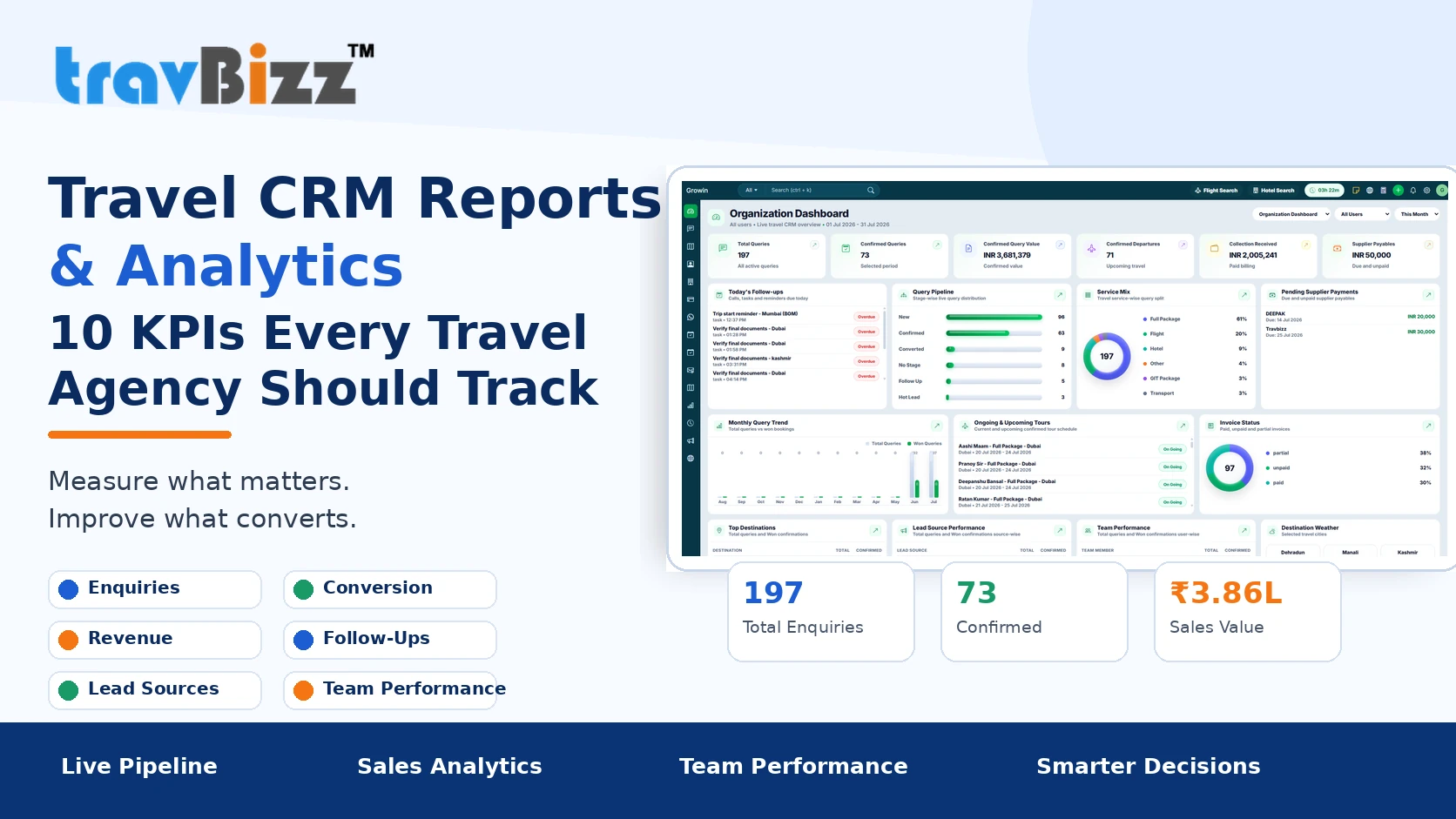
Travel agencies collect a large amount of sales information every day: new enquiries, follow-ups, quotations, confirmed bookings, lost leads, payment values and salesperson activity. If this data only exists inside individual chats or spreadsheets, management cannot easily see what is working and where revenue is being lost.
Travel CRM reports turn day-to-day activity into measurable business information. The goal is not to create more reports for the sake of reporting. It is to give owners and sales managers a small set of useful KPIs that help them make faster decisions, coach the team and improve conversion.
1. Total enquiries received
The first KPI is the number of genuine travel enquiries entering the business during a selected period. This creates the top of the sales funnel and helps management compare demand across days, weeks, months and campaigns.
A useful enquiry report should also show source, salesperson ownership and enquiry type so the agency can understand where its leads are coming from and whether marketing activity is producing real opportunities.
2. First-response time
Travel customers often contact several agencies at once. The time between receiving an enquiry and the first meaningful response can therefore influence conversion significantly.
Tracking first-response time helps managers identify whether leads are being handled quickly and whether certain team members, shifts or channels are creating delays. The objective is not just speed; it is consistent speed with a useful response.
3. Follow-up completion and overdue follow-ups
A CRM should show how many scheduled follow-ups were completed and how many became overdue. This KPI reveals whether the sales process is disciplined or dependent on memory.
A team may have many open leads but still perform poorly if the next actions are constantly missed. Overdue follow-ups are therefore one of the most actionable daily metrics for a travel sales manager.
- Follow-ups due today
- Completed follow-ups
- Overdue follow-ups
- Leads without a next action
- Average overdue time
4. Lead-to-booking conversion rate
Conversion rate shows what percentage of travel enquiries eventually become confirmed bookings. It is one of the most important indicators of sales effectiveness because it connects lead volume with actual outcomes.
The overall number is useful, but deeper analysis is even more valuable. Agencies can compare conversion by lead source, salesperson, destination or package type to identify where the strongest opportunities are coming from.
5. Quotation-to-booking conversion rate
Not every enquiry reaches the quotation stage, so it is useful to measure what happens after a proposal is shared. Quotation-to-booking conversion shows whether the agency's proposals, pricing and follow-up process are moving customers toward confirmation.
If many quotations are being created but very few are converting, the problem may be response quality, pricing, slow revisions, weak follow-up or poor qualification earlier in the process.
6. Average booking value
Average booking value shows how much revenue a typical confirmed booking contributes. This helps management understand whether the agency is growing only through more bookings or also through higher-value business.
The metric can be analysed by destination, product type, salesperson or customer segment. It is also useful when evaluating whether upselling and premium package strategies are improving over time.
7. Sales value and confirmed revenue
Agencies should track both the number of bookings and the value of those bookings. A month with fewer but higher-value confirmations may be stronger than a month with many low-value transactions.
CRM dashboards can show confirmed sales value by period, team member or product category so management has a clearer picture of commercial performance instead of relying only on lead counts.
8. Lead source performance
Marketing decisions become better when the CRM records where each enquiry originated. Website forms, Google campaigns, referrals, social media, repeat customers and offline channels may all produce different conversion rates and booking values.
Lead-source reporting helps the agency see which channels bring volume, which bring quality and which are consuming time without producing enough revenue.
- Enquiries by source
- Conversion rate by source
- Booking value by source
- Average response time by source
- Lost-lead rate by source
9. Salesperson performance
A fair salesperson report should measure more than total bookings. It should also consider lead allocation, response activity, follow-up completion, conversion rate and sales value. This gives management a more balanced view of performance.
The purpose is not only ranking employees. Good reporting helps identify training needs, workload imbalance and best practices that can be shared across the team.
10. Lost leads and lost reasons
Lost leads contain valuable information. If the CRM records why opportunities were closed, management can identify recurring problems such as price mismatch, slow response, unavailable inventory, destination changes or customers choosing another agency.
Without lost-reason reporting, the same problems can continue for months without being visible. A simple lost-lead report can therefore become one of the strongest sources of process improvement.
Bonus KPI: repeat booking rate
Repeat booking rate shows how much of the agency's business is coming from customers who have booked before. It is a useful indicator of customer satisfaction, service quality and long-term relationship strength.
Agencies that depend entirely on new leads often face higher marketing pressure. Growing repeat business can make revenue more predictable and reduce dependence on constant lead acquisition.
How to build a useful Travel CRM dashboard
A dashboard should prioritise action, not decoration. Owners and managers should be able to open the CRM and quickly understand what needs attention today as well as how the business is performing over the selected period.
A practical dashboard can combine top-level sales KPIs with operational alerts so the team sees both results and the work required to improve those results.
- Today's new enquiries
- Follow-ups due and overdue
- Current pipeline by stage
- Confirmed bookings and sales value
- Top lead sources
- Salesperson performance
- Lost reasons
- Repeat customer activity
Avoid vanity metrics
More data does not automatically mean better management. Reports become less useful when the dashboard is filled with numbers that do not lead to decisions.
Choose KPIs that connect directly to response speed, follow-up quality, conversion, revenue and customer retention. If a number changes and no one knows what action to take, it probably does not deserve a prominent place on the main dashboard.
How TravBizz supports travel sales reporting
TravBizz Travel CRM is built around travel enquiry and sales workflows, helping agencies organise leads, ownership, follow-ups and booking-related activity in one place. This structured data makes it easier to review performance through dashboards and reports rather than collecting separate manual updates from the team.
When the CRM becomes the central source of sales activity, managers can spend less time asking for status and more time improving the process behind the numbers.
Final takeaway
The most useful Travel CRM reports are the ones that connect daily sales activity with business outcomes. Start with enquiries, response time, follow-ups, conversion, booking value, lead sources, salesperson performance and lost reasons.
Once these KPIs are tracked consistently, a travel agency can identify bottlenecks earlier, invest in better lead sources, coach the team with real data and build a more predictable sales operation.
Put these ideas into practice with TravBizz
Connect your sales, itinerary, operations and customer workflows with travel technology designed for agencies.
Frequently asked questions
What are the most important Travel CRM KPIs?
Important KPIs include total enquiries, first-response time, overdue follow-ups, lead-to-booking conversion, quotation conversion, average booking value, sales value, lead-source performance and lost-lead reasons.
What should a travel agency CRM dashboard show?
A useful dashboard should show new enquiries, pipeline stages, follow-ups due, overdue tasks, confirmed bookings, sales value, lead sources and team performance without overwhelming the user with unnecessary data.
How do travel agencies calculate lead conversion rate?
Lead conversion rate is generally calculated by dividing confirmed bookings by the number of relevant enquiries in the same cohort or period and multiplying the result by 100.
Why should a travel agency track lost lead reasons?
Lost reasons help management understand why customers are not converting and identify recurring issues such as price, response delays, inventory problems or weak follow-up.
Can CRM reports help improve salesperson performance?
Yes. Reports can highlight response times, follow-up completion, conversion and sales value, helping managers coach staff with actual activity data instead of assumptions.
Are CRM reports useful for small travel agencies?
Yes. Even small agencies benefit because a few clear KPIs can show where enquiries are coming from, which follow-ups are being missed and whether the business is converting enough leads into bookings.