Travel CRM vs Generic CRM: Why Travel Agencies Need Industry-Specific Software
Compare Travel CRM vs generic CRM and understand why travel agencies need industry-specific workflows for enquiries, quotations, follow-ups and booking conversions.
Why this comparison matters for travel businesses
Many travel agencies start with a generic CRM because it sounds flexible and familiar. On paper, a generic CRM can store contacts, notes, tasks and sales stages. The problem starts when the agency needs the CRM to reflect real travel workflows rather than a basic sales list.
Travel sales depends on details such as destination, travel dates, number of travellers, quotation status, itinerary revisions, payment follow-ups and time-sensitive customer communication. When these details are forced into a generic system, the team spends more time adjusting the software than using it to sell. That is why the Travel CRM vs generic CRM decision matters so much for agencies that want a smoother lead-to-booking process.
What a generic CRM usually does well
A generic CRM is designed to serve many industries. It usually helps businesses manage contacts, track conversations, log tasks and view a simple pipeline. For companies with straightforward sales cycles, this can be enough.
If an agency only needs a contact database and a basic task reminder system, a generic CRM may appear attractive in the beginning. It often covers universal functions but leaves industry-specific structure to manual customisation.
- Store customer contact details
- Record activities and notes
- Create tasks and reminders
- Track a simple sales pipeline
- Generate basic reports
What travel agencies need beyond a basic CRM
Travel agencies do not just sell a simple product. They handle changing requirements, custom itineraries, multiple destinations, live customer discussions, revisions and booking coordination. A Travel CRM needs to keep the commercial and travel context together so that salespeople can understand each enquiry quickly.
For example, an enquiry is not just a name and phone number. It may also involve tentative travel dates, traveller count, package type, destination preferences, quotation versions, decision stage and outstanding next actions. A travel-specific CRM is built around this reality.
- Destination and route information
- Travel dates and duration
- Number of adults, children or groups
- Quotation and itinerary tracking
- Follow-up scheduling linked to the enquiry stage
- Booking and payment context
Where generic CRM starts slowing down a travel team
A generic CRM often treats every lead the same way. The agency then has to create manual fields, custom notes and workarounds just to capture essential travel information. Instead of making the team faster, the system can create extra steps and inconsistency.
This becomes more visible when several team members handle leads. One salesperson may store destination information in notes, another may use a custom field, and someone else may leave details inside WhatsApp. Management gets fragmented data and the team loses clarity.
- Travel requirements get scattered across notes and chats
- Quotation progress is hard to monitor
- Managers cannot easily see which leads need action
- Follow-ups depend too much on memory
- Sales and operations context stay disconnected
A Travel CRM is built around travel workflows
A Travel CRM is not only a contact system. It is designed around the way a travel agency actually works. It can connect enquiry capture, salesperson assignment, requirement details, quotations, follow-ups and conversion tracking inside one workflow.
Because the structure already matches the business, the team does not have to reinvent the process from scratch. This reduces training friction and helps salespeople focus on handling customers rather than managing software complexity.
- Lead capture from travel enquiry sources
- Clear enquiry ownership
- Travel requirement fields that matter
- Quotation and itinerary progress visibility
- Stage-wise follow-up discipline
- Conversion-focused reporting
Quotations, follow-ups and conversions need travel context
One of the biggest differences between a Travel CRM and a generic CRM appears after the first response. Travel leads usually involve quotations, option discussions and revisions before the booking decision happens. If the CRM cannot easily connect those actions to the lead, the team starts relying on manual coordination again.
A travel-specific system makes it easier to know which quotation was shared, when the next follow-up is due and which leads are close to conversion. That is far more useful for a travel agency than a generic lead record with disconnected notes.
Manager visibility improves with an industry-specific CRM
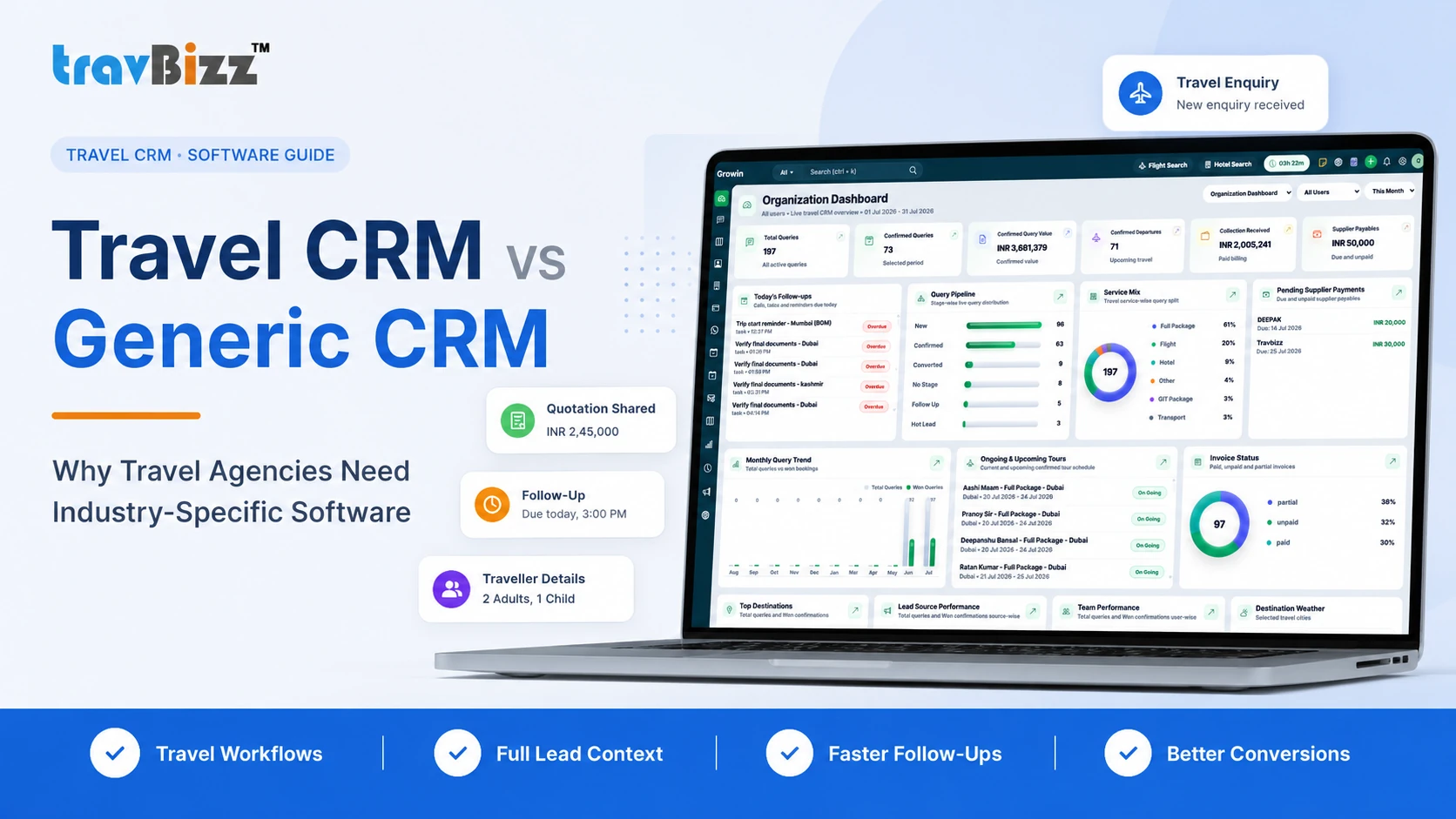
Travel business owners need more than a list of open contacts. They need to know how many enquiries are new, how many quotations are waiting for customer response, which leads are hot, which team members have overdue follow-ups and where bookings are getting delayed.
A Travel CRM makes these questions easier to answer because the data structure matches the travel sales process. Instead of asking the team for separate status updates, managers can review activity inside the system itself.
- New and untouched enquiries
- Overdue follow-ups
- Hot leads pending decision
- Quotation stage visibility
- Lead-owner performance
- Booking conversion trends
Can a generic CRM still work for a travel agency?
Yes, but mostly in limited situations. A very small agency with a simple process and low enquiry volume may manage for a while using a generic CRM if the team is comfortable adding manual structure around it.
The challenge is long-term fit. As enquiry volume grows and multiple team members start handling quotes, follow-ups and customer communication, a generic CRM usually needs increasing levels of custom work. At that point, the business often realises that it would rather use software designed for travel from the start.
What to evaluate before choosing between Travel CRM and generic CRM
Do not choose only on the basis of contact storage or a basic dashboard. Instead, evaluate how well the system supports your real travel sales workflow from enquiry to booking.
The best choice is the one that reduces manual coordination, makes follow-up easier and helps the team convert more leads with less confusion.
- Can it capture complete travel requirements?
- Does it support quotation and itinerary tracking?
- Can every lead have a visible next action?
- Will managers get useful pipeline visibility?
- Is the workflow simple enough for the team to adopt?
- Does it suit future growth, not only current size?
How TravBizz supports travel-specific CRM needs
TravBizz Travel CRM is designed for travel businesses that need structured enquiry management, follow-up discipline and better sales visibility. Instead of treating travel enquiries like generic sales contacts, it helps agencies manage the details and actions that actually affect booking conversion.
For agencies comparing Travel CRM vs generic CRM, the main question is simple: do you want a CRM that can be adapted for travel, or one that is already aligned with travel workflows? In practice, industry-specific alignment usually means less manual effort and faster execution.
Final takeaway
A generic CRM can handle broad contact management, but travel agencies need more than a general system. They need travel requirement tracking, quotation visibility, follow-up control and a workflow that matches the lead-to-booking journey.
That is why a Travel CRM usually becomes the better long-term choice. When the software matches how the agency actually sells, the team works faster, managers gain clarity and more enquiries have a better chance of becoming confirmed bookings.
Put these ideas into practice with TravBizz
Connect your sales, itinerary, operations and customer workflows with travel technology designed for agencies.
Frequently asked questions
What is the difference between Travel CRM and generic CRM?
A Travel CRM is designed specifically for travel business workflows such as enquiry management, quotation tracking, itinerary-related follow-ups and booking conversion. A generic CRM provides broader contact and pipeline tools but usually requires more manual setup for travel use cases.
Why do travel agencies need an industry-specific CRM?
Travel agencies handle destination details, travel dates, quotations, revisions and time-sensitive follow-ups. An industry-specific CRM keeps these workflows organised in one system, which makes sales execution easier and more consistent.
Can a travel agency use a generic CRM?
Yes, especially at a very small scale. However, as enquiries increase, generic CRMs often need more customisation and manual work to support travel-specific sales processes.
Does a Travel CRM improve follow-up management?
Yes. A Travel CRM can make follow-up management stronger by linking reminders and next actions directly to travel enquiries, quotations and lead stages.
Which CRM is better for quotations and travel leads?
For most travel agencies, a Travel CRM is better because it is built to handle travel enquiry context, quotation progress and booking-oriented follow-up more naturally than a generic CRM.
Is Travel CRM only for large travel agencies?
No. Small and growing agencies can also benefit because a travel-specific CRM helps them stay organised early and reduces the need for manual coordination as they scale.