B2B vs B2C Travel CRM: Which One Does Your Travel Agency Need?
Understand the real difference between B2B and B2C travel CRM workflows, the features each model needs and how to choose the right setup for your travel agency.
Why the B2B vs B2C difference matters in travel
Many travel businesses search for a travel CRM and assume every system will fit every sales model. In practice, the workflow of an agency selling to direct customers is very different from the workflow of a business dealing with sub-agents, corporate clients or channel partners. When the process is different, the CRM requirements also change.
A B2C travel CRM usually focuses on lead capture, follow-ups, customer communication, quotations and conversion from direct enquiries. A B2B travel CRM must also handle partner relationships, negotiated rates, account ownership, repeated business, payment cycles and operational coordination at scale. Choosing the right model early helps the team avoid workaround-heavy software later.
What a B2C travel CRM usually needs
In a B2C setup, the main objective is to respond quickly, understand traveller requirements clearly and keep every enquiry moving toward confirmation. The CRM should make it easy to capture leads from website forms, calls, WhatsApp or social channels and convert them into structured enquiry records.
Sales teams also need a clean timeline of activities, reminders for follow-ups, quotation history, traveller preferences and basic payment or document visibility. The stronger the follow-up discipline, the better the conversion rate tends to be in a direct-customer environment.
- Quick enquiry capture with travel dates, destinations and pax details
- Lead assignment and ownership
- Daily follow-up reminders and activity history
- Quotation and itinerary sharing
- Customer notes, documents and payment tracking
- Clear stage-wise pipeline from new lead to won or lost
What a B2B travel CRM usually needs
A B2B workflow involves more than one-off lead conversion. Travel companies working with agents, resellers, corporate accounts or distribution partners must manage relationship history, rate coordination, repeat quotations and longer commercial cycles. The CRM should support the account-level view as well as individual booking opportunities.
Because partner business is often recurring, the system should help teams track who the partner is, which destination or segment they sell, what turnaround time is expected, the current status of discussions and the commercial background behind each request. A generic sales CRM may capture contact information, but it often misses travel-specific operational detail.
- Partner or company records with contact persons
- Account-based enquiry and booking history
- Team coordination across sales and operations
- Repeated quotation workflows for ongoing business
- Supplier, costing and service-level visibility
- Payment follow-up and partner relationship management
When an agency actually needs both B2B and B2C workflows
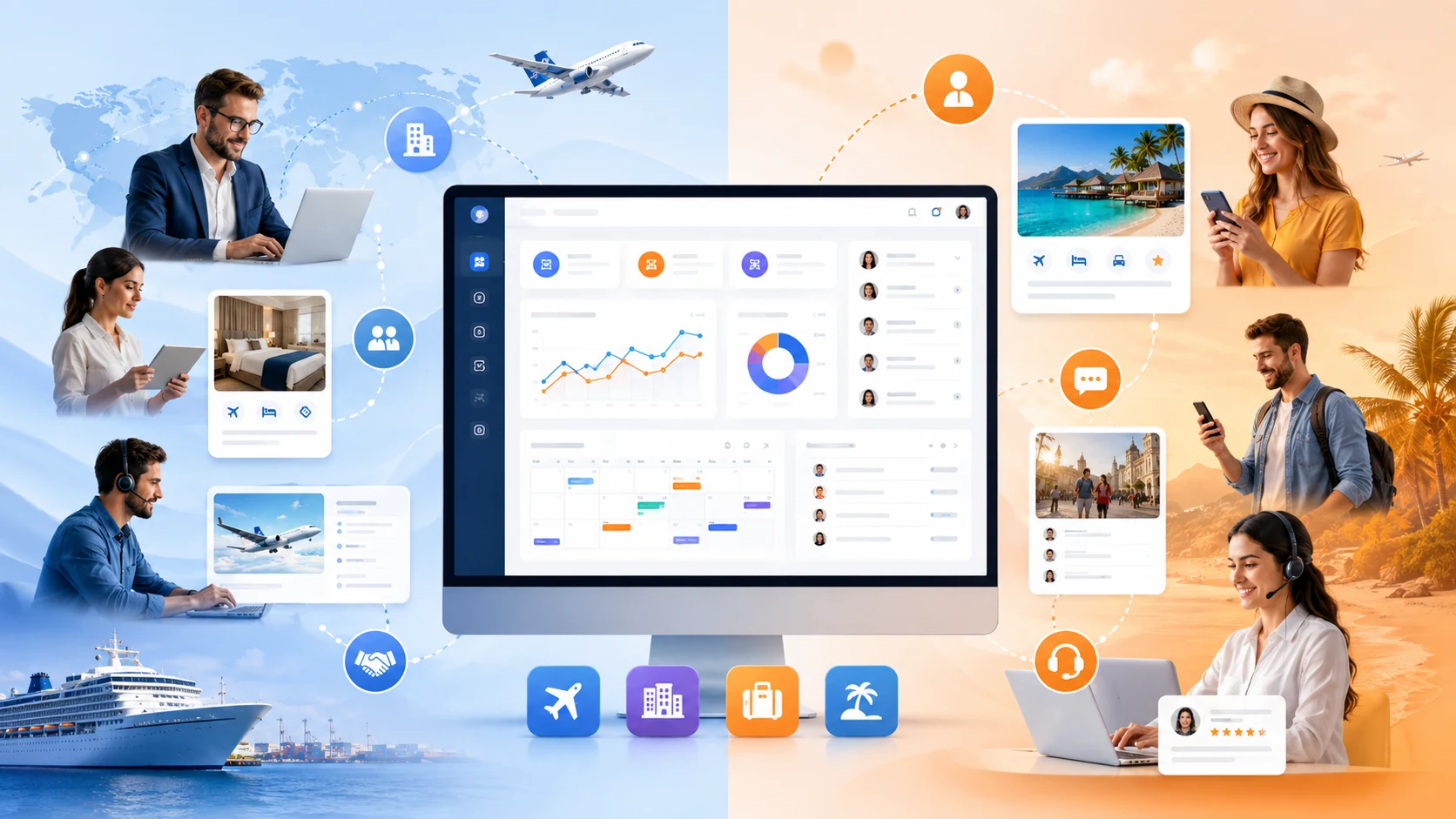
Many travel businesses do not operate in a single model. A company may run direct holiday enquiries from its website while also handling business from corporate clients, franchise partners, resellers or sub-agents. In that case, the problem is not choosing B2B or B2C; the real requirement is a CRM that can support both without forcing the team into duplicate processes.
This is where travel-focused software becomes more useful than a generic CRM. The same platform should be able to organise direct enquiries, maintain partner accounts, manage quotations and keep the internal workflow connected to itinerary and operations modules.
- You receive both direct customer leads and partner enquiries
- Different teams handle retail and trade business
- You need separate communication context for travellers and partners
- Quotations depend on actual travel services and costing
- Management wants unified reporting across all business sources
Features that make the difference while comparing options
When evaluating software, do not only ask whether the CRM has contacts and pipelines. Ask whether it matches the way your travel business sells and fulfils trips. A good travel CRM should connect enquiry data with itinerary, costing, documents, activities and reporting rather than leaving the team to manage each part separately.
It also helps if the system supports custom stages, proper reminders, company records, service-specific notes and visibility for both sales and operations. The closer the CRM is to the real workflow, the higher the adoption rate will be across the team.
Why generic CRM tools often fall short for travel agencies
Generic CRM platforms can be useful for broad sales activity, but travel businesses often need enquiry details that are very specific: destinations, departure dates, number of passengers, rooming, hotel and transport notes, package costing, supplier references and the final itinerary. If these details live outside the CRM, the software becomes only a partial record.
That creates double work. The sales team updates one tool for follow-up, another for quotations and maybe a spreadsheet for costing. A travel-specific CRM reduces this fragmentation by keeping customer, commercial and trip-related details closer together.
How to decide what your agency should implement now
Start by mapping where your last fifty enquiries came from and how they moved to confirmation. If most business comes from direct customers, prioritise lead speed, follow-ups and quotation control. If a large share comes from repeat partners or corporate accounts, prioritise account management, coordination and commercial tracking.
If both models are meaningful for your business, avoid choosing a tool that only solves one side well. The better long-term decision is a travel CRM that supports mixed workflows and can grow with your agency rather than forcing a migration once the business expands.
Put these ideas into practice with TravBizz
Connect your sales, itinerary, operations and customer workflows with travel technology designed for agencies.
Frequently asked questions
What is the difference between B2B and B2C travel CRM?
A B2C travel CRM is mainly focused on direct customer enquiries, follow-ups, quotations and conversion, while a B2B travel CRM also manages partner accounts, repeat business, commercial relationships and longer sales cycles.
Can one travel agency need both B2B and B2C CRM workflows?
Yes. Many travel companies handle both direct travellers and partner or corporate business. In that case, they need a travel CRM that can support both workflows inside one connected system.
Why is a generic CRM often not enough for travel businesses?
Generic CRMs may track contacts and activities, but travel agencies also need destination details, passenger requirements, quotations, itineraries, costing and trip-related workflow that generic tools often do not handle well.
Does TravBizz support B2B and B2C travel CRM workflows?
Yes. TravBizz is built for travel businesses and can help manage direct enquiries as well as structured travel sales and operational workflows required in broader B2B or mixed models.