What Is Travel CRM? Complete Guide for Travel Agencies & Tour Operators in 2026
Learn what Travel CRM really means, how it helps travel agencies and tour operators manage enquiries, follow-ups, quotations, itineraries and operations, and what to look for in the right system.
What Travel CRM means in practical terms
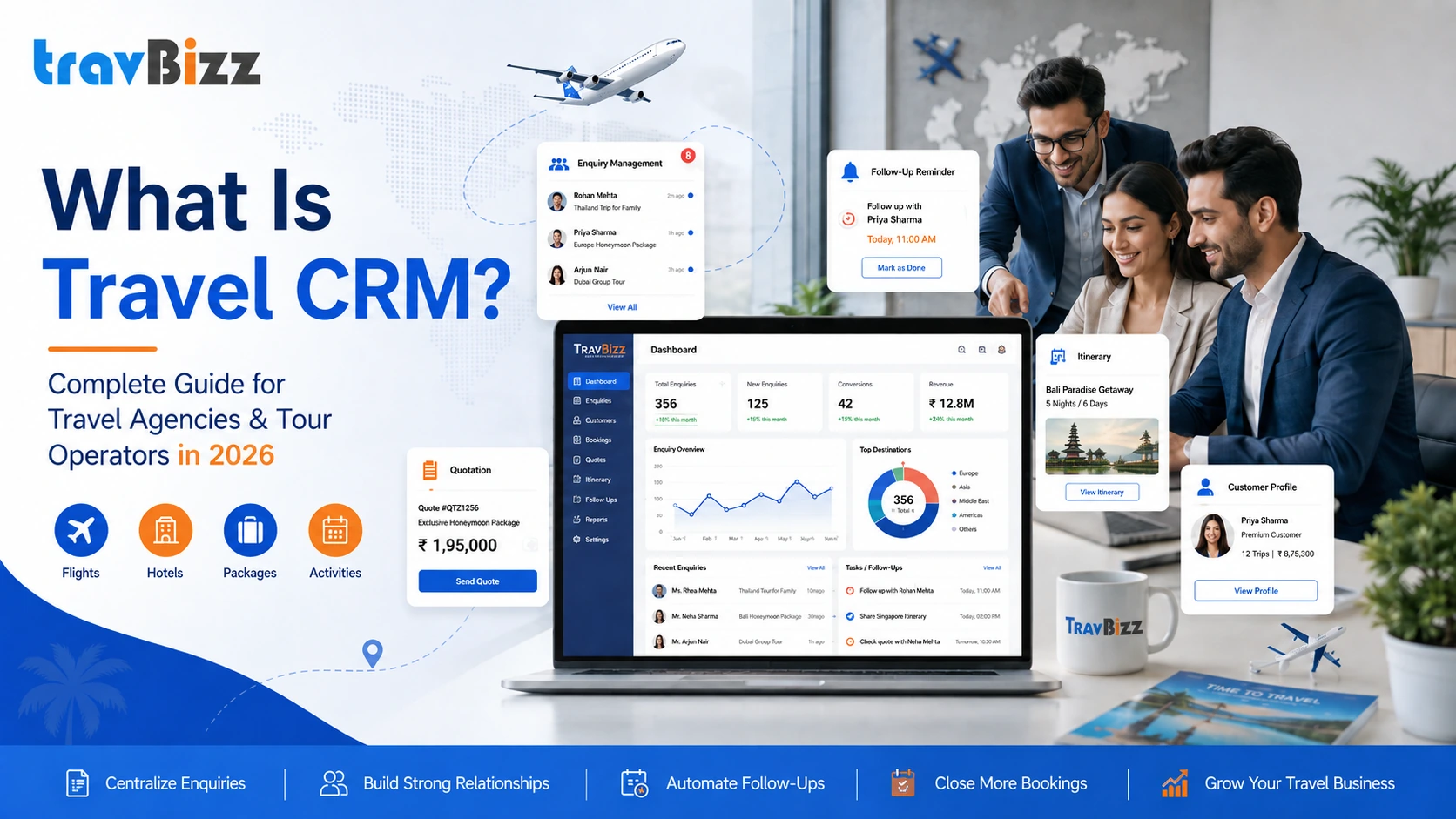
Travel CRM stands for travel customer relationship management software. In simple terms, it is a system that helps travel agencies, tour operators and travel sales teams manage enquiries, customer communication, follow-ups, quotations, booking-related details and the overall customer journey in one organised place.
A generic CRM can store contacts and basic sales notes, but a travel CRM is designed around how travel businesses actually work. It should handle destination requirements, travel dates, number of passengers, itinerary discussions, quotation revisions, documents, reminders and booking progress rather than treating every enquiry like a standard sales lead.
Why travel businesses need a dedicated CRM
Many agencies start with WhatsApp, email and Excel. That may work when the enquiry volume is low and one person remembers everything. The problem begins when multiple team members are involved, more leads arrive every day and customers expect quick responses across several channels.
Without a proper workflow, follow-ups get missed, quotation versions get scattered, customer requirements stay inside personal chats and management loses visibility over what the team is doing. A travel CRM solves this by giving the business a single operating system for sales and customer handling.
- One place for all enquiries and customer records
- Faster follow-ups with reminders and task history
- Clear visibility into quotation and booking status
- Better team coordination between sales and operations
- Less dependence on memory, spreadsheets and scattered chats
What a travel CRM usually includes
A strong travel CRM normally begins with lead and enquiry management. It should let the team capture new requirements quickly, assign ownership and track the stage of every enquiry. Beyond that, it should support quotation management, itinerary-related communication, customer notes, reminders and document handling.
More advanced travel CRM software also connects reporting, payment tracking, supplier or service information and performance dashboards. The exact feature depth depends on the size and workflow of the business, but the basic objective remains the same: organise the customer journey and improve conversion discipline.
- Enquiry capture and lead assignment
- Follow-up reminders and activity timeline
- Quotation and proposal tracking
- Customer records and communication history
- Itinerary and travel requirement visibility
- Payments, reports and team coordination
How the workflow typically moves inside a travel CRM
A practical travel CRM should map closely to the way travel sales works in real life. It usually starts when a customer or partner submits an enquiry by phone, website form, WhatsApp, email or referral. The team records the requirement, assigns it and schedules the next follow-up.
Once the conversation advances, the salesperson prepares a quotation or itinerary, records revisions and moves the lead through stages such as new, in progress, quoted, hot, won or lost. This creates a visible flow instead of a hidden process spread across individual devices and inboxes.
- Enquiry received
- Requirement captured
- Lead assigned
- Follow-up scheduled
- Quotation or itinerary shared
- Customer decision tracked
- Booking confirmed or lead closed
Who should use travel CRM software
Travel CRM software is useful for more than one kind of travel business. Small travel agencies need it to stay organised as leads grow. Tour operators need it to manage customised requests and repeated follow-ups. DMCs and larger teams need it for structured collaboration, reporting and process visibility.
Even businesses that already have strong salespeople benefit from CRM because performance becomes less dependent on one person's memory. The system becomes the process, which is important if the company wants to scale or maintain service quality consistently.
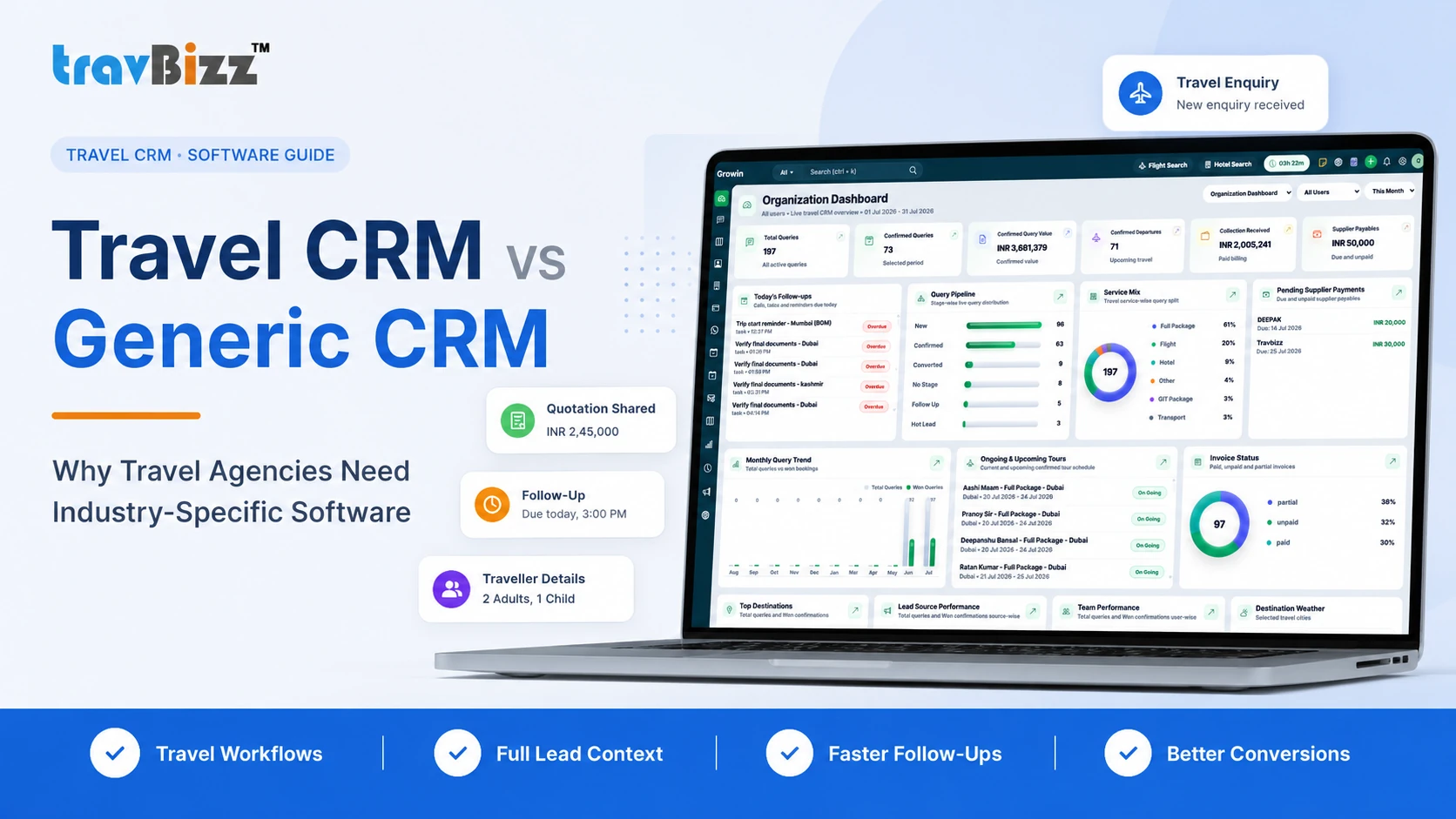
Travel CRM vs a generic CRM
The biggest difference is relevance. A generic CRM may be good at broad pipeline management, but travel businesses usually need more detailed operational context. Customer destination preferences, travel dates, number of passengers, rooming, package revisions and itinerary discussion are all central to the sale.
If those travel details sit outside the CRM, the team ends up maintaining several systems at once. A travel CRM reduces this fragmentation by making the enquiry, quotation and customer workflow more travel-specific from the beginning.
What to look for before choosing the right system
Do not select software only by counting features on a sales page. Start with your current workflow and ask whether the CRM makes daily work easier. The right system should reduce manual follow-up tracking, make enquiry ownership clear and give management better visibility without adding complexity.
It also helps to check whether the software can grow with the agency. A CRM should support today’s sales process while leaving room for better reporting, stronger team collaboration and connected travel workflows as the business expands.
- Easy enquiry entry and fast adoption by the team
- Useful follow-up reminders and activity tracking
- Travel-specific fields and workflow stages
- Quotation and itinerary visibility
- Reporting that helps management take action
- Scalability as the business grows
Why Travel CRM matters even more in 2026
Customer expectations are faster now than they were a few years ago. Travellers compare options quickly, ask for revisions rapidly and expect agencies to remember earlier discussions. At the same time, agencies compete harder for every lead. A travel CRM helps businesses respond with more consistency and less confusion.
In 2026, the agencies that stay organised will generally convert better than the ones still managing critical customer information across personal devices and disconnected spreadsheets. That is why travel CRM is no longer just a nice-to-have system; for many agencies, it is becoming core operating infrastructure.
Put these ideas into practice with TravBizz
Connect your sales, itinerary, operations and customer workflows with travel technology designed for agencies.
Frequently asked questions
What is Travel CRM?
Travel CRM is customer relationship management software designed specifically for travel agencies, tour operators and travel businesses to manage enquiries, follow-ups, quotations, customer records and travel-related sales workflows.
Why do travel agencies need a CRM?
Travel agencies need a CRM to organise enquiries, reduce missed follow-ups, track quotations, centralise customer information and improve team coordination as lead volume grows.
How is Travel CRM different from a normal CRM?
A travel CRM is built around travel-specific workflows such as destinations, dates, passengers, quotations, itineraries and booking-related communication, while a generic CRM usually focuses on broader sales activity.
Does TravBizz offer Travel CRM software for agencies?
Yes. TravBizz provides travel CRM software designed to help agencies manage enquiries, follow-ups, quotations, itineraries and customer workflow in one connected system.